Baking Challah,
Braid of Memory & Meaning
By Louise Jacobsen Fisher
 “Feeding my family challah made by my hands is, for me, feeding them the spirituality of Shabbat,” says Blair Rush-Gove of Passaic, N.J. “Besides being one of the three mitzvot—or commandments—specifically for women, challah baking clears my mind. I think about the women for thousands of years who have come before me making their challah for their families. I also think about the creation of the world. I try to infuse spirituality into my bread to give to my family.”
“Challah baking enables me to work with my hands,” says Marc Zweben, a construction lawyer and father of three living in Potomac, Md. “It’s really very gratifying to bake challah, and the kids know that ‘Daddy’s challah’ is special for Shabbat.” He adds in a whisper: “The secret for a really fluffy challah is to double the rising time.”
Whether it’s the loftier goals of spirituality and communion with God or the down-to-earth lure of fresh baked bread that pulls family and friends to the Shabbat dinner table, Jewish women—and men—are baking challah every week. Busy people with full-time jobs and parenting responsibilities are taking the time to continue an ancient Jewish tradition when they could easily throw an extra loaf of bread into the grocery cart.
“My fresh-baked challah is very meaningful to my family and me, and at the same time, it’s so easy,” says Potomac’s Shelly Wiener, a full-time CPA and mother of two teenage boys who bakes challah every week—even during tax season. “Our week centers on Shabbat. The rest of the week, it’s a quick dinner and homework. But having a homemade challah on the table symbolizes a different meal that is slower and more relaxed. It all goes together,” she says. “Every Jewish life event has food, from weddings to Shabbat. For my family, it’s a special event when my challah is there.”
When Diane Prystowsky is not working in her Charleston, S.C., music store or busy with her three teenagers, she is baking challah—especially for the High Holidays. “Great excitement builds for the holidays when the smell of my homemade challah fills our house. It would not be the holidays without it. I have friends who expect a loaf every year, even though last year I was so busy that the Rosh Hashanah challahs were ready for breaking the Yom Kippur fast,” she says, laughing.
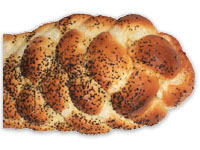
Each loaf represents the uniqueness of the baker. “Curiosity started me on challah baking,” says Wiener. “I always wondered how the same ingredients could turn out so differently depending upon the baker.” Like many challah bakers, once Wiener perfected the bread baking basics, she began to experiment. “There was the sun-dried-tomatoes-and-olives phase, and then a series of minced-onion challahs, but my kids liked the chocolate-chip challah experiments the best.” Wiener is meticulous and precise, and her challahs are picture-perfect with even braids. Each has a shiny egg gloss, baked to a pale honey hue, and is lightly sprinkled with poppy seeds.
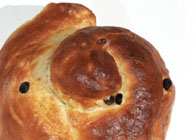
“I go all out with my challahs for the holidays,” says Prystowsky, who bakes lofty, round, sweet challahs with cinnamon, raisins, and pecans. “They are round to symbolize continued friendship into the New Year.” A purist, she hand-kneads all her challah dough. “I’ve got to have my hands in it from the beginning. For me, it’s the only way to tell if the dough has the right texture.” To add a Southern twist, Prystowsky sometimes rolls her challah dough in finely ground grits. The result, which she calls her Charleston Challah, is crispy on the outside and soft on the inside.
Then there are challahs that are measured not with the eyes, but with the emotions. “Blair’s challah is fulfillment or contentment,” a dinner guest says of Rush-Gove’s bread. “It’s the most gratifying comfort food around.” Adds another guest: “Her challahs look average. But they are special because of the way they melt in your mouth and because she has made them with care just for us.”
Anyone can bake challah. The well-tested techniques and shortcuts that follow will save preparation time and effort.
One of the most obvious time savers is to use a bread machine to prepare the dough. After about 90 minutes, the dough is ready for braiding. Many bread machines have a time-delay option, so ingredients can be assembled in the morning and be ready for braiding at the end of the workday.
Another shortcut is to make challah dough with a bread maker or by hand, dividing it into one-pound portions that you freeze. Remove from the freezer Thursday night or Friday morning, defrost, braid, and let rise before baking.
Make challah baking a family experience. Older children can assemble the ingredients in the bread maker, while younger children can roll dough ropes and braid, or add raisins or chocolate chips. Parents can supervise the baking.
Try the basic challah recipe below for two 1-pound loaves. Once you have mastered the bread-making process, experiment by adding extra ingredients. Before braiding the bread, for example, add a handful of chocolate chips or a teaspoon of fresh or dried herbs, or a quarter cup of finely chopped dried apples and whole golden raisins. For a sweeter challah, add two more tablespoons of sugar.
Hand method: Dissolve yeast and a pinch of the sugar in warm water in a large bowl. Allow mixture to rest for 5 minutes until creamy and small bubbles appear. Beat eggs before adding to yeast mixture, followed by sugar and salt. Add flour, a cup at a time, until it is difficult to stir the mixture. Transfer dough to a lightly floured work surface and knead for 7 to 10 minutes until smooth and springy.
Transfer dough to a very large, lightly oiled bowl, and cover with plastic wrap. Set aside in a warm place for 1 to 11/2 hours until the dough doubles in size. Transfer to a lightly floured work surface and divide dough into two equal pieces. Then divide each piece into three equal pieces and roll into 10-inch ropes, braid, and pinch ends together to seal. Place on a lightly oiled cookie sheet and let rise for 30 minutes before baking at 350 degrees for 25 minutes.
Bread-maker method: Assemble all ingredients per manufacturer’s instructions in the bread-maker container and select dough option. Follow above instructions for braiding and baking.
Louise Jacobsen Fisher is a food writer and feeds challah to most of her Potomac, Md., neighborhood.
Basic Challah
1 cup warm water (105 to 115 degrees)
2½ teaspoons yeast
 2 eggs
1/3 cup sugar
1 teaspoon salt
4 1/4 cups bread flower