|
Keep On Rockin’ Me, Baby
Jewish women are reaching for the ring of rock music stardom.
By Debra Nussbaum Cohen
On an early episode of the Showtime series The L Word, the alt-rock band Betty played a concert. As guitar player Elizabeth Ziff rocked out, a big Jewish star necklace swung from around her neck. It was one of those moments that sent my Jew-dar into a beeping frenzy.
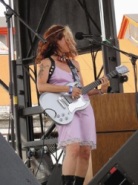
Elizabeth Ziff |
Could it be that this Betty babe was a Yiddishe mama?
When tracked down through the band’s Web site, she coolly said yes.
“I wore my huge Jewish star on The L Word to represent,” says Ziff.
She is just one of a growing number of women in rock who are coming out—as Jews.
|
Although there are still plenty of Jewish women in rock who change their names to something considered more commercial—feminist rocker Pink was born Alecia Moore and dance-music diva Taylor Dayne started out a decidedly more suburban-sounding Leslie Wonderman—a growing number are keeping their names and working references to Jewishness in their work.
| When singer-songwriter Patti Rothberg, who is 34, was preparing to release her first album with the major label EMI in 1996, her then-manager pressed her to change her name. “She thought that middle America would not want a Patti Rothberg,” she says. “My feelings were hurt. We ended up going with my name. Everything else felt phony and wrong.”
“Getting into the 1990s, there was much more Jewish pride and awareness on the part of performers and musicians than in previous decades,” says Scott Benarde, author of Stars of David: Rock‘n’Roll’s Jewish Stories (Brandeis University Press).
|

Patti Rothberg
|
“The turning point was [in 1996] when Adam Sandler’s Hanukkah song outed all these people and was embraced by mainstream radio,” he says.
To be sure, the popular music industry is and has always been heavily populated by Jews—folk, rock and pop music have since the earliest days of the genres been filled with Jews (see box on page 15)—though mostly behind the scenes as writers, promoters, managers and producers. But there have been some Jewish women famous for being out in front performing, like Carole King (née Carole Klein) and Barbra Streisand. They remain a relative rarity, however.
Genya Ravan has been one of them: an original rock star innovating every step of her career, and one of the few women on stage in raw first-wave rock.
Born in 1940 in a displaced-persons camp in Poland, Ravan—then Genyusha Zelkowitz—came to this country seven years later with her parents and sister. Her parents were too traumatized to speak about their experiences during the war, leaving questions unanswered, her mother continuously on the verge of hysteria, and Genya eager to escape a difficult home life.
Blessed with beauty, she started doing “cheesecake” modeling. At Brooklyn’s Lollipop Lounge in 1962, a friend dared her to get on stage and sing. It started her on her musical journey; the following year, she and a friend formed the first-ever girl group whose members played their own instruments. Goldie and the Gingerbreads were a quick hit.
It wasn’t easy being some of the first women to play rock, Ravan says.
“The first thing always said to us when we worked was ‘Do you broads really know how to play?’” she recalls with a nicotine-stained laugh during a recent interview at her home in upstate New York.
Soon after the band broke up in 1967, a jazz musician boyfriend told Goldie she sounded black when she sang, and urged her to take a name that reflected it—like Raven. So she tweaked it and took it, and has since called herself Genya Ravan.
With friends she formed the jazz-rock group Ten Wheel Drive, which she fronted during its brief life, from 1968–70. With both groups she toured the U.S., England and the rest of Europe, appearing with the Rolling Stones, the Who, Janis Joplin, and Blood, Sweat and Tears, among others. After Ten Wheel Drive crashed, she struck out on her own.
Her first solo album came out in 1972. Two years later, when her father died, she called an album Goldie Zelkowitz, putting her undeniably Jewish name out there in his memory. “Everybody thought it was hysterical, that it was pretty ballsy,” says Ravan.
At about that time she became the first woman asked by a major label, RCA, to produce someone else’s record. Since then, she has produced her own work and others’, and in the 1980s was influential on the New York punk scene.
|
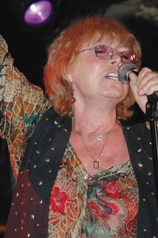
Genya Ravan
|
Ravan’s own singing style is much more R&B. Her throaty alto goes from bluesy soul to cabaret-style crooning, and then into kick-ass rock—all in the space of a couple of songs.
“My soulfulness has a lot to do with my Judaism,” she says. “I used to say that my slow songs, my ballads, felt like davening. There’s a very spiritual praying feeling. If I didn’t have singing, I don’t know what would have happened to me. It was my prayer, my primal scream, rolled up in one. I have not been closer to God than when I’m singing.”
|
In her 2004 book, Lollipop Lounge: Memoirs of a Rock and Roll Refugee (Billboard Books), she relates riveting stories about the early days of the rock world, about lovers both male and female, about her descent into drug and alcohol addiction, about her climb back up, and about how hard it was to be a woman in a male-dominated industry.
“I had to work twice as hard because I was a woman. Not fair, but it made me who I am,” she says. “I was a tough cookie in the studio. If you didn’t respect me, it was over. If you were going to argue with me, I would walk out. I knew I had one thing working against me—that I was a woman. When a guy expresses what he wants and is adamant, people will say he knows what he wants. When a woman does, she’s automatically labeled difficult. I’ve had tons of that experience.”
Young women today have an easier time in the rock business, she says. “The doors now are more open. They’re certainly more accepted. There’s a big difference. They’re not coming from the dark ages.”
Women on the Rise
Among the current crop of marquee female rock stars in the U.S., few are Jews. But take it down a notch to those who aren’t yet household names, and you’ll find a number of Jewish women among the rising stars.
Regina Spektor, born in the former Soviet Union and raised in the Bronx (where she practiced piano on a synagogue upright), started getting a lot of play with her third CD, Soviet Kitsch, which brought her slickly edgy sound and lyrics to a larger audience.
On her first tour she opened for The Strokes, when she was just an unsigned newbie and had to pay her own plane fare and hotel bills. Today she has the power of Sire Records promoting her new album, Begin to Hope.
“Spektor is the most visible, but there’s been no huge new star,” says Benarde.
“There are an equal number of women out in the music world, but Jewish women haven’t made it, haven’t reached that level of critical success,” agrees Michael Dorf, the New York impresario of Jewish and alternative music, and founder of The Knitting Factory. “They have crossed into the lower levels of successful rock, but not at the level of a Fiona Apple or Joni Mitchell.”
Still, lots of Jewish women pepper rock music as performers, including Ani DiFranco, Sleater-Kinney’s Carrie Brownstein and Janet Weiss, and Nina Gordon of Veruca Salt.
None of them seem to be very “out” as Jews. But then, the music industry doesn’t encourage religious or ethnic distinctiveness.
“People don’t tout their religion or ethnicity, anything that separates them from the broadest possible audience,” says Rachael Sage, 33, a singer-songwriter who lives in New York City’s East Village and has her own label, MPress Records.
But among some Jewish women whose songs climb the charts, there seems to be an increasing willingness to talk about how being Jewish has informed their work.
Singer-songwriter and actress Lisa Loeb has been trying to convince her friend Jill Sobule, another successful singer-songwriter, to go with her to her synagogue in L.A.
While she was growing up in Dallas, Loeb’s family attended a Reform temple “on all the Hallmark holidays,” Loeb says. Now she goes to synagogue on Saturday mornings.
The professional breakthrough for Loeb, 39, came when her song “Stay” was on the soundtrack to the 1994 movie Reality Bites and climbed its way to the No. 1 single position on the pop charts—making her the only unsigned artist ever to occupy the spot.
“Interpretation of Torah is a skill I use when I’m writing and editing lyrics and trying to explain something in a poetic way, with imagery-oriented words,” she says. “That’s a tradition in Judaism, that kind of process,” she says.
The fact that so many of the original singer-songwriters were Jewish is no accident, she says.
“Being introspective is also built into Jewish tradition. There’s a lot of attention to life events, birth, death, going through transitions in your life, and the need to write about it and express it with other people.
“Back in the day when the overall culture was less focused on talking about feelings, some of that was already in the Jewish tradition. Even if you’re not writing autobiographical songs, you’re looking at character and behavior to tell a story.”
| Loeb’s pal Sobule has a girlish voice that falls somewhere between Cyndi Lauper’s and Suzanne Vega’s. Her pop songs come from a decidedly female place and occasionally relate to things Jewish. They include “The Resistance Song” and “Attic,” in which the lyrics ask, “Would you have hidden me in your attic…?” Sobule says, “That’s my ultimate love test for someone. |
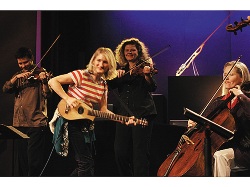
Jill Sobule
|
“I always have WWII songs. We can’t get over that, you know? I embrace it,” she says.
Janice Ian, one of the original singer-songwriters to hit it big in the 1970s, wrote “Tattoo” about a young girl struggling to survive in a concentration camp.
“She steps out of line to the left/and her father to the right/One side’s a cold, clean death/The other is an endless night./Gold from a grandmother’s tooth/mountains of jewelry and toys/piled in the corners/mailed across the borders/presents for the girls and boys/Tattoo.
“And it gets darker every night/spread-eagled out among the stars, she says/Somewhere in this tunnel lives a light/still my beating heart/I have never known a man./What man will want me now?/Am I still alive, somehow?/If I can survive, somehow?/Tattooed.”
|
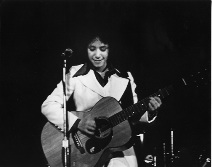
Janice Ian
|
In an interview from her Nashville home, Ian says, “I had always wanted to write about the Holocaust, but it’s a very intimidating subject, especially for a three-minute song. I was here in Nashville and heard a singer, a non-Jewish guy, do a song about the Holocaust. If he could do it, I certainly could. So I started it that night.”
The song appears on her 1993 album Breaking Silence.
|
Ian, born Janis Fink, took her brother’s middle name as her new last name when she started performing in the Village as a teenager. It wasn’t to disavow her Jewish affiliation, she says, but rather to protect her family from being hassled.
She describes herself today as an occasional synagogue attendee, having been raised in a culturally, but not religiously, Jewish family. As a child she absorbed stories of Jewish history and heroism from her immigrant grandmothers.
“My ethical sense, my moral compass, is deeply rooted in Judaism. It runs all through my work, that you stick up for the underdog, you don’t discriminate against people, you let people live their life,” she says.
Holiday Spirit
Ian hasn’t recorded a Christmas song, but many Jews have put out entire albums of Christmas material. Just last year, Bette Midler released one. Barbra Streisand, Barry Manilow (né Pincus) and Neil Diamond have each recorded not one, but two Christmas albums. And “smooth jazz” sax player Kenny G (né Kenneth Gorelick) has put out three.
It seems to be a direction taken more often by the baby-boomer stars than their Gen X and Y successors. Younger Jews not known to be at all religiously involved evince a Jewish pride not seen in the generation before. Sobule’s answer to the Christmas frenzy is her hilariously punk-klezmer anthem “Jesus Was a Dreidel Spinner.”
“Jesus was a dreidel spinner/And this we can’t forget/Paul was Saul before he was Paul and the Last Supper was a Seder/Jesus was a dreidel spinner/And all his disciples were too/So all you Christians remember/Your Lord was a Jew. So light the menorah/tinsel the tree/give thanks to the wise men and the Maccabees. Jesus was a dreidel spinner/Turned water into wine/He did lots of miracles but he never ate pork rind/Christmas is for everyone/Hanukkah is too/All you remember/Your Lord was a Jew.”
Patti Rothberg doesn’t see herself making a Christmas song, either. “I don’t play Christmas music. I have a nondenominational holiday single, ‘Snow Is My Downfall.’”
Though she says her primary attachments to Judaism at the moment are culinary, she adds, “I don’t think I would ever make a Christmas album. I’m not strictly religious myself, but I would feel strange doing it.”
| Toby Lightman, 28, is a New York City-based singer-songwriter whose work is hard-hitting and bluesy. Lightman, who says, “Being Jewish hasn’t really impacted my work,” recorded something more secular.
“Atlantic asked me this year to do a holiday song. I did a generic winter song, ‘Sleigh Ride.’”
She couldn’t go to the Jew side, though, because “there aren’t too many Hanukkah songs that would work for a lot of people. I wasn’t going to record the dreidel song.”
|
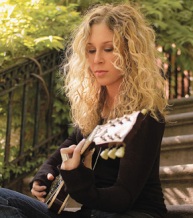
Toby Lightman
|
Even though things have gotten better than a few decades ago, all of the musicians interviewed said that it’s a lot harder to be a woman in their field than it is to be Jewish.
“Being Jewish oftentimes brings a great connection with a lot of other people,” says Loeb. “Like when you’re trying to talk about things that don’t have anything to do with work, the Jewish holidays are a great point of connection.
On the other hand, “being a woman, it was hard to be taken seriously sometimes when I was on a major label.”
According to Ian, who has been observing the industry for more than three decades, “things have changed and not. In general you’re not seeing female players out there, and not female songwriters the way you see male songwriters. I don’t know why that is.
“It’s harder for younger women in a lot of ways. The industry has gotten so big, it’s easier to get lost,” says Ian. “There’s less give and take between musicians because people are so busy. We always ran into each other at the same clubs, the same hotels, and the same flights. That’s a lot of the reason you had the incredible blossoming of music in the 1960s and ’70s. It was very much about music, not about ‘making it,’” she says. “That just doesn’t happen anymore. Now it’s an industry. It’s completely different. It’s U.S. Steel.”
It’s Her Own Business
Unless you’re Beyoncé—wait, even if you are Beyoncé—a key to longevity in today’s music business is diversification and keeping control of budgets, marketing and the product.
Loeb is a good example of how successful young women in rock often have several pots simmering at once: She used to have a cable cooking show with then-boyfriend Dweezil Zappa, and last year had a reality dating show called #1 Single on the E! channel. She’s now working on Camp Lisa, a new CD of kids’ music that will also appeal to parents. Also in the works are a cookbook and a regular album, she says.
|
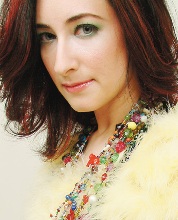
Rachael Sage
|
Sage, who got her musical start in Hebrew school, will soon come out with her eighth album. She tours 150 to 200 days a year. And she runs her own record label, MPress, whose logo is a hamsa, the Middle Eastern-Jewish hand sign believed to be a symbol of good fortune.
Though at one point pursued by a major label, Sage felt it was important to have control over her own music.
|
“I have a handful of friends who’ve been on major labels, and most of the time it’s been heartbreak. They record albums that never see the light of day, or they do and nothing really happens and they spend the next two years trying to buy them back from the label so they can sell them at gigs,” she says.
Married With Children … Maybe
None of the women interviewed for this article are married or have children. When asked where they see their lives in 15 years, several of them mentioned that they hope to have families.
But that’s a difficult mix for women in rock.
“People want their pop singers to be single. It would be different if they’re really established,” says Freddie Katz, Patti Rothberg’s producer.
In Lollipop Lounge, the ever-candid Ravan discusses having had abortions.
“I didn’t have children because of my career. My career was everything to me. And I didn’t want to have a kid without a father. I couldn’t, I was running all over the place,” says Ravan. “It’s very difficult for a woman on the road to have a relationship, unless you’re screwing one of your musicians or a fan, and that’s basically what happened.
“I had three abortions, which I’m really sorry about. That’s my biggest regret today. I should’ve had at least one of them [the babies],” she says.
The young women now walking the professional path Ravan paved for them acknowledge that it would be difficult to pair work and family life.
“Hopefully one day I’ll be able to do something like that,” says Lightman. “But now we travel primarily in a van, staying in hotels, driving from place to place. It’s very hard. It’s tiring.”
Like many women before her who have reached for the elusive ring of rock music super-stardom, Lightman says, “I definitely want to get married and have kids and have all of that for the rest of my life.
“But for now I need to ride this wave and see where it takes me.”
Debra Nussbaum Cohen is a freelance writer whose articles appear in the New York Jewish Week and the New York Times.
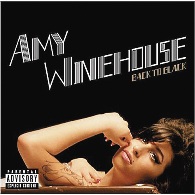 A New Star From Britain A New Star From Britain
That London’s Amy Winehouse, is brassy, bold, tattooed, and consumes alcohol to excess is clear to anyone who has followed her antics in the British tabloids. What is also evident, though, from listening to her latest CD—Back to Black—is that the openly Jewish Winehouse, 23, can really sing. Soulful and wrenchingly honest (think ‘60s R&B merged with present-day rap and hip hop) her music garners a well-deserved audience on both sides of the pond.
Since its October release, Back to Black has gone gold in the U.S. and triple platinum in the U.K. On top of that, Winehouse has received the 2007 BRIT award for best female solo artist.
Jazz was in the air in her North London home: Many family members were professional jazz musicians and her parents raised her on a steady diet of the greats (which helps explain comparisons of Winehouse to Billie Holiday and Sarah Vaughn).
|
|

 Advertising Info



