|
 Getting in Gear for the High Holidays
Let’s face it. If you’re not a regular at synagogue (or even if you
are), thinking and reading about spiritual issues can transform the High Holidays
from a chore into a wellspring of meaning and personal growth. Here are some
new and recent books and CDs to jump-start the process.
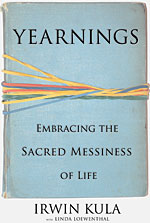
In his new book, Yearnings: Embracing the Sacred Messiness of Life (Hyperion,
$23.95), Rabbi Irwin Kula breaks free of dogma and traditional God-language
to vividly demonstrate how our ancient traditions can help us wrestle with life’s
challenges. Instead of being “anachronistic or confining,” he suggests,
our religious ideas “when turned inside out offer dynamic, adaptable, even
radical methods for broadening our perspective in all areas of life.” Kula,
president of CLAL—The National Jewish Center for Learning and Leadership—and
host of a 13-part national public television series, Simple Wisdom With Irwin
Kula, uses true-life examples to show how the yearnings and discomforts we experience
can prompt questions and insights that inspire us to new ways of being and believing.
Provocative, engaging and transforming, Yearnings is a shofar blast of a book
that will open your eyes and stir you, inspiring you to break free of inertia
and move forward in your spiritual evolution.
 While many of us may not think about God throughout most of the year, during
the High Holidays it’s unavoidable. To Rabbi David Aaron, author of Inviting
God In: Celebrating the Soul-Meaning of the Jewish Holy Days (Trumpeter/Shambhlala,
$21.95), each Jewish holiday offers us the opportunity to have “a date
with God,” a reminder of the profound connection “that often gets
overshadowed by the hustle and bustle of life.” Using biblical references,
anecdotes and midrashim, he explains how each holiday reveals God’s abiding
love for us. Rosh Hashanah, for example, is a day of judgment when God looks
at everything we’ve done, both good and bad, in the previous year. But
it is also a day to “take inventory” of our actions and make changes
to improve. “Viewed from that perspective,” Aaron writes, judgment
is actually empowering. It tells me that God cares about my choices and that
I make a difference in this world.” Aaron, who lives in Jerusalem, frequently
lectures in North America. He is the founder of Isralight, an international
organization that helps participants experience how Judaism enriches every aspect
of their daily lives.
While many of us may not think about God throughout most of the year, during
the High Holidays it’s unavoidable. To Rabbi David Aaron, author of Inviting
God In: Celebrating the Soul-Meaning of the Jewish Holy Days (Trumpeter/Shambhlala,
$21.95), each Jewish holiday offers us the opportunity to have “a date
with God,” a reminder of the profound connection “that often gets
overshadowed by the hustle and bustle of life.” Using biblical references,
anecdotes and midrashim, he explains how each holiday reveals God’s abiding
love for us. Rosh Hashanah, for example, is a day of judgment when God looks
at everything we’ve done, both good and bad, in the previous year. But
it is also a day to “take inventory” of our actions and make changes
to improve. “Viewed from that perspective,” Aaron writes, judgment
is actually empowering. It tells me that God cares about my choices and that
I make a difference in this world.” Aaron, who lives in Jerusalem, frequently
lectures in North America. He is the founder of Isralight, an international
organization that helps participants experience how Judaism enriches every aspect
of their daily lives.
 |
|
 High Holiday Resources
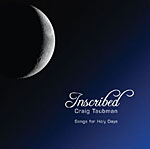
In years past, Jews would rely on chazzanot (cantors) with operatic voices to capture the drama and power of the High Holiday liturgy. Inscribed, a soulful CD with new melodies by singer/songwriter Craig Taubman approaches the liturgy in a contemplative vein. Quietly powerful and uplifting, it creates a bridge between the ancient liturgy and the modern worshipper. Over 200 congregations are using music from the CD in their services. To learn more, go to .
The path to redemption, the Unetane Tokef prayer recited on Yom Yippur tells us, lies in repentance, prayer and charity. An innovative guide from the Religious Action Center of Reform Judaism offers both individuals and congregations a wealth of suggested activities for incorporating tzedakah-acts of righteousness-into their holiday practices around three social justice themes: Hunger, Environment and the Judicial System. The downloadable guide can be found at .
The potential for renewal and for building a more meaningful life is one of the most powerful themes running through the High Holiday liturgy. In the book, A Second Chance: God's Gift of Renewal, Los Angeles author/photographer Hallie Lerman takes readers on a spiritual journey through exquisite black and white photos and compelling interpretive text. The springboard for the theme is the thanksgiving offering that Rabbi David Wolpe of Sinai Temple in Los Angeles brings after recovering from a life-threatening illness. The Rabbi commissioned a scribe to write a Torah, and journeys to Israel with member of his congregation to complete it. Lerman takes part in the experience, which comprises the first part of the book, and then explores the theme of renewal in nature and the Jewish experience of renewal after the Holocaust with the birth of the State of Israel. This is a book that will inspire and move anyone who seeks the strength and faith to embrace a second chance at life. To learn more, go to .
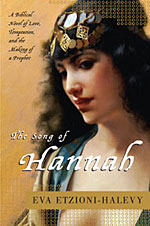 On the first day of Rosh Hashanah, the biblical story read as Haftorah, the text following the Torah reading, is the story of Hannah, whose deeply felt prayer for a son is one of the most powerful in the Jewish tradition. Israeli novelist Eva Etzioni-Halevy, a professor emeritus of political sociology at Bar Ilan University, uses this moving story from the Book of Samuel as the inspiration for The Song of Hannah, her recent novel. As in most of the recent biblically inspired novels, Etzioni-Halevy humanizes her characters and adds romance. To learn more and to share thoughts about the book, go to .
|
| |
|
|
 Advertising Info



